

In 2026, relying solely on spreadsheets is the surest way to lose profit margins—a loss you won’t even notice amid the rush of daily tasks. Most managers feel a growing sense of frustration when they can’t pinpoint exactly at which stage customers are dropping off or how much they actually earned on a project after accounting for every hour the team worked. This is precisely where a modern sales management system ceases to be a mere technological add-on and becomes the foundation of profitability in the increasingly competitive Polish market.
You’re probably all too familiar with that moment when the sales team promises deadlines it can’t meet, and the lack of information flow generates unnecessary costs and stress. This is a classic scenario in which the absence of a centralized system blurs accountability and profits. In this article, you’ll learn how to effectively transition from document chaos to full control over every stage of your business process. We’ll show you how to implement a transparent sales funnel and automated profitability reports that will create a single, reliable source of truth for every client and project in your company. It’s time to regain control and peace of mind when managing your financial results.
Key Findings
- You’ll learn why spreadsheets are holding your business back and when it’s time to switch to a professional sales management system.
- You’ll learn about key tools, such as automated quoting and funnel visualization, that allow you to quickly identify and eliminate bottlenecks in the process.
- You’ll discover how a thorough pre-implementation analysis protects your budget from a failed investment in software that doesn’t fit your business reality.
- You’ll understand how integrating the CRM module with cost control and time tracking provides a complete picture of the actual profitability of each project.
- You’ll learn how to choose scalable, user-friendly solutions so that new technology becomes a real asset rather than just another burden for the team.
Table of Contents
-
What is a sales management system, and why is Excel not enough?
-
How to Choose a Sales Management System Tailored to the SME Sector?
-
Pre-Implementation Analysis: Your Safeguard Against a Failed Investment
What is a sales management system, and why is Excel not enough?
Many entrepreneurs start with a simple spreadsheet, believing that it’s enough to manage their processes. The truth, however, is harsh. A professional sales management system is much more than a digital notebook. It’s an advanced, modular platform that integrates CRM functions, quoting tools, and in-depth business analytics into a single ecosystem. It allows you to move from reactive management—that is, putting out fires—to a proactive strategy based on hard data.
Excel, while versatile, quickly becomes a barrier to growth. Spreadsheets lack relationships between data, which makes it impossible to automatically track customer history or changes in project budgets. Worse still, as operations scale up, the risk of human error in formulas increases dramatically. A single incorrect entry can distort the picture of the entire company’s profitability, leading to decisions that generate losses instead of profits. Centralizing information in a dedicated system eliminates this problem by creating a single, secure source of truth for every client and every quote issued.
It’s important to understand that the foundation of such solutions is a definition of a customer relationship management system that emphasizes building long-term value. However, a modern sales management system expands on this concept to include operational efficiency. Instead of wondering what went wrong last month, managers can monitor the flow through the sales funnel in real time and take action before a sales opportunity is lost forever.
Signs that your company needs a professional system
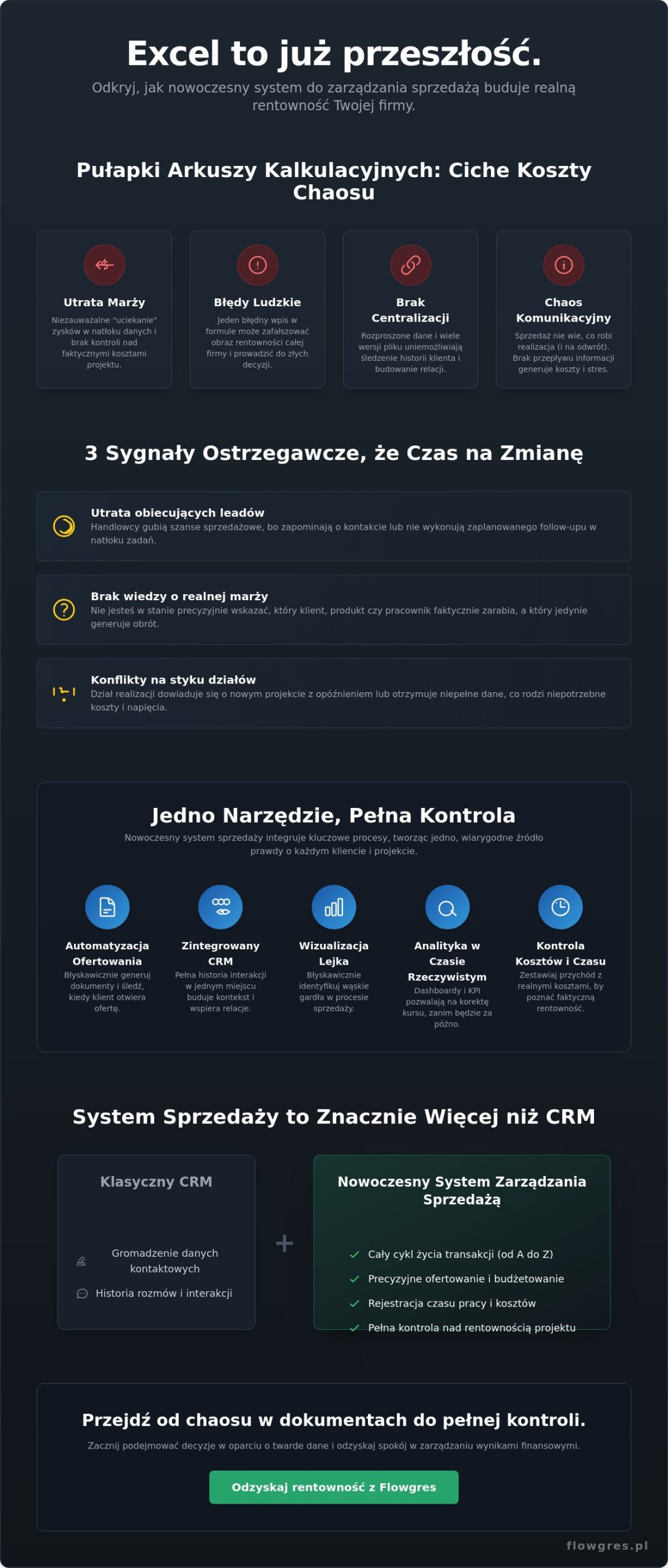
If you feel like you’re losing control of your business, pay attention to specific warning signs. The most common one is losing promising leads simply because a salesperson forgot to follow up or failed to carry out a scheduled follow-up. Equally dangerous is a lack of reliable information about profit margins. Without a system in place, it’s difficult to determine which product or employee is actually contributing to the company’s bottom line, and which is merely generating revenue. Problems also arise at the interface between departments. When the sales team closes a deal, but the fulfillment team learns about it late or receives incomplete data, communication chaos becomes inevitable.
Sales Management System vs. Traditional CRM—What Are the Differences?
Traditional CRM focuses primarily on collecting contact information and conversation histories. In contrast, a sales management system covers the entire transaction lifecycle, from the initial inquiry, through precise quoting, all the way to settlement and payment. A key advantage is integration with budgeting. Simply knowing that a sale has been closed is only half the battle. True control begins when the system allows you to match revenue with actual labor and resource costs. This approach supports internal communication and builds trust with business partners, who receive consistent information at every stage of the collaboration.
Key features of a sales system that drive profitability
Closing a deal is just the beginning of the path to actual profit. Many companies fall into the trap of celebrating a sales success that, in reality, turns out to be unprofitable due to an incorrect estimate of fulfillment costs. A modern sales management system must offer a suite of tools that go beyond a simple contact database to support a thorough evaluation of each contract.
The foundation of effectiveness is precise management of the sales funnel. Visualizing each stage allows you to instantly identify bottlenecks where processes lose momentum. By understanding key sales management processes, managers can stop guessing and start planning actions based on the actual status of deals. The most important features that build a competitive advantage include:
-
Quotation Automation: Instant document generation and the ability to track when a customer opens a quote allow you to respond at the perfect moment.
-
Integrated CRM module: A complete history of interactions provides the context needed to personalize your approach without having to search through emails every time.
-
Real-time analytics: Dashboards displaying the team’s KPIs allow you to adjust course before poor quarterly results become a reality.
It’s worth considering implementing a solution that combines these aspects into a single system, such as a comprehensive business management system where sales and fulfillment seamlessly integrate.
Integration with Budget and Cost Management
This is where the biggest difference lies between a standard CRM and a profit-oriented system. Combining sales data with operating costs prevents projects from being underestimated as early as the quoting stage. The system automatically calculates the margin, giving you confidence that a given contract will actually contribute to the company’s bottom line rather than merely generating empty revenue. Tracking additional costs during negotiations allows you to adjust the final price on the fly, protecting the company’s financial interests.
Work Time Tracking as Part of the Sales Process
An often-overlooked cost is the time spent on so-called presales. The hours spent by engineers or experts preparing complex proposals have a measurable value. Monitoring this effort allows you to assess whether a particular type of client is worth the time investment of your most valuable specialists. Additionally, resource scheduling provides a clear answer to the question of whether the team has the capacity to take on a new order without the risk of delays that could result in contractual penalties or reputational damage.
How to Choose a Sales Management System Tailored to the SME Sector?
Choosing the right software is one of the most important operational decisions for a small or medium-sized business. A poor investment not only wastes the budget but, above all, discourages the team from making any technological changes in the future. The ideal sales management system for the SME sector should, above all, be modular. This means you don’t have to implement all available features right away. You can start with a basic CRM module and, as your business grows, add additional features such as time tracking or a resource planner. Paying only for the tools you actually use is the simplest way to maintain high profitability.
Equally important are ease of implementation and an intuitive user interface (UX). If the system is too complicated, salespeople will start avoiding it, reverting to their personal notebooks and scattered files. The tool must support their daily work, not become yet another burdensome administrative task. It’s worth checking how the solution you choose integrates with the ecosystem you’re already using. Seamless integration with email, a calendar, or an internal corporate help desk system allows for the instant flow of information without having to constantly switch between windows. Also, keep security in mind. In the Polish context, full compliance with the GDPR and high standards of data encryption are the absolute foundation for protecting your customer database.
The Cloud or a Local Server—Which Should You Choose in 2026?
Most companies in the SME sector are now opting for the SaaS (Software as a Service) model. Cloud-based solutions guarantee full accessibility from anywhere in the world, which is crucial for hybrid teams or sales representatives working in the field. The cloud relieves you of the burden of managing server infrastructure and handling automatic updates. On-premises installation remains an option only for organizations with very specific regulatory requirements or unique processes that preclude standard solutions. By 2026, an advanced mobile app that allows you to check a project’s status or contact history directly during a client meeting will also be the norm.
Hidden Costs vs. the True Value of Implementation
When choosing a tool, don’t fall into the trap of the lowest subscription price. Cheap systems often turn out to be the most expensive in the long run when the need arises to modify them or integrate them with other tools. True return on investment (ROI) is calculated based on the time saved by employees and increased efficiency in closing deals, not just by comparing monthly invoices. Professional business consulting is a key element of success. A partner who understands your industry and can help tailor the sales management system to your actual needs is worth far more than just access to the application. A thorough pre-implementation analysis is an investment that protects your capital from being wasted.
Pre-Implementation Analysis: Your Safeguard Against a Failed Investment
Many companies make the same costly mistake: they purchase software licenses and only then figure out how to integrate them into their day-to-day operations. This is a sure path to failure. Market statistics are unforgiving and show that as many as 70% of IT system implementations fail or fail to meet their intended business objectives. The technology itself is rarely to blame. More often than not, the failure stems from a lack of thorough preparation and understanding of the processes taking place within the organization. Before you choose a specific sales management system, you need to know exactly what you want to optimize.
A business process audit is nothing more than a thorough assessment of your successes and failures. It helps you understand how your company sells today and how it wants to sell tomorrow. Without mapping your needs, you risk investing in modules that will remain unused, while the real problems facing your sales team continue to generate losses. A professional pre-implementation analysis acts as a safeguard that protects your budget from waste and ensures that the technology will provide real support for your employees.
Stages of a Professional Needs Analysis
This process begins with in-depth interviews with key personnel at the company. We talk to the owners about their vision for growth, to managers about their reporting needs, and to sales representatives about the challenges they face in the field on a daily basis. This multifaceted approach allows us to precisely identify “bottlenecks” in the flow of information—issues that management is often unaware of. The result of this work is detailed technical and functional documentation. This documentation serves as a roadmap, ensuring that the sales management system is implemented efficiently, on time, and within budget.
Business Consulting as Added Value
There is one golden rule of modern management: never automate chaos. If your current sales process is inefficient, implementing a system will simply cause you to generate poor results faster. Business consulting allows you to correct these mistakes before writing a single line of code. We help optimize the customer journey and support your team in shifting to a work culture based on hard data rather than gut feelings. This is the foundation of a long-term strategy for developing your company’s IT ecosystem. If you want to avoid common project mistakes and build a market advantage from the start, check out our pre-implementation analysis and gain confidence in your investment.
Flowgres: Modern Sales, Budget, and Cost Management
Most tools available on the market cease to be useful the moment a sales representative changes the status of a sales opportunity to “won.” This is a mistake that costs Polish companies thousands of zlotys in undetected losses. Flowgres is a sales management system designed with the entire project lifecycle in mind. We bridge the gap between the world of sales and the harsh reality of operating costs. By integrating CRM, quoting, HelpDesk, and project management modules, you gain a tool that not only helps you close deals but, above all, ensures that they are profitable.
Financial transparency is the cornerstone of Flowgres. Our budget management module lets you track every penny spent during order fulfillment. Instead of waiting for reports from accounting, you can see your actual margin in real time. The system automatically reconciles revenue with the team’s labor costs and additional expenses. This centralization of data eliminates communication barriers between the sales department and the project execution team. Everyone works based on the same, reliable source of truth about the client and the project.
Flowgres’ Modular Structure—Start with Sales, Expand Based on Costs
We understand the unique nature of the SME sector, which is why we’ve prioritized complete flexibility. You don’t have to implement the entire system all at once. You can start by organizing your customer relationships in the CRM module, and then gradually add time tracking or advanced scheduling features. A unique advantage of Flowgres is its built-in helpdesk system for businesses. After-sales support becomes an integral part of the loyalty-building process, rather than an isolated silo of information. Meanwhile, the resource planner allows you to manage people just as effectively as sales funnels, preventing team overload and delays.
Why is Flowgres a partner and not just a supplier?
When you choose Flowgres, you gain the support of a Polish team that thoroughly understands the realities of the local market. You’re not just another number in a global support system. We offer direct contact with experts and a real say in the software’s development. We constantly update our features based on feedback from Polish entrepreneurs, adapting the tool to changing regulations and business needs. This approach means that Flowgres is not just code, but above all, support in optimizing your business. If you want to stop guessing and start actually making money on every contract, schedule a free demonstration of the Flowgres system and see how we can transform your day-to-day operations.
Choose a technology that boosts your bottom line
In 2026, business success will depend on the speed at which decisions are made based on hard data, not on gut feelings. Replacing scattered spreadsheets with an integrated solution isn’t just a matter of convenience—it’s primarily about safeguarding your profit margin. A professional sales management system allows you to link the quoting process to real-time tracking of costs and labor hours. This gives you a complete picture of each project’s profitability even before it’s completed. Remember that technology should be a tool that supports your team, and a thorough pre-implementation analysis is the best way to avoid mistakes that could cost your company thousands of zlotys.
As a Polish technology company, we fully understand the challenges faced by domestic entrepreneurs in the SME sector. Flowgres offers a modular structure that grows alongside your organization, providing access to professional consulting at every stage of our partnership. Don’t let operational chaos hinder your growth and erode your hard-earned profits. Discover the Flowgres system and streamline your company’s sales, gaining peace of mind and full control over your business processes. It’s time to move from intuition to precise management that builds a lasting competitive advantage.
Frequently Asked Questions
Is a sales management system suitable for a small business?
Yes, a professional sales management system is crucial precisely for smaller businesses, where every lead and every zloty of profit margin matters immensely. It allows small teams to handle more processes without having to drastically increase their headcount. By automating repetitive tasks, salespeople can focus on building relationships rather than tediously filling out spreadsheets.
How long does it take to implement the Flowgres system?
The implementation time depends on the specific processes in your company, but it usually takes anywhere from a few weeks to three months. A key factor influencing the pace of work is a thorough pre-implementation analysis, which eliminates the risk of having to make corrections later on. Thanks to Flowgres’ modular design, you can start with the most important features in a short amount of time and then gradually expand the system with additional modules.
Can the sales system be integrated with my current email account?
Yes, integration with popular email clients and calendars is a standard feature that significantly improves the user experience. All messages exchanged with a business partner are automatically assigned to their profile in the system. This allows every team member to instantly review the history of agreements, which eliminates communication chaos and builds a professional image of the company in the eyes of the customer.
How does a sales management system differ from a standard CRM?
The main difference lies in the scope of control over the entire business process. While traditional CRM focuses primarily on building relationships and maintaining a contact database, a comprehensive sales management system also covers quoting, budgeting, and cost analysis. It is a tool that allows you to track a contract’s profitability from the initial inquiry all the way through the final project settlement, providing a complete picture of the company’s financial health.
How does a pre-implementation analysis affect the cost of implementing an IT system?
A pre-implementation analysis is an investment that effectively reduces the final cost of implementation by eliminating unnecessary expenses. It allows you to precisely determine which features are essential, thereby preventing the purchase of unused modules. By thoroughly mapping out your processes, you avoid costly changes during the development phase, which protects your budget from unforeseen additional costs and delays.
Is my data secure in the cloud?
Yes, data stored in the cloud is protected by advanced encryption protocols and regular backups, which often exceed the security standards of on-premises servers. The Flowgres system is fully compliant with GDPR guidelines, which guarantees the highest level of protection for your business partners’ information. We use professional data centers that ensure system continuity even in the event of hardware failures.
How does a sales management system help calculate project profitability?
The system automatically matches revenue from a given offer with actual operating costs, such as team working hours or expenses for subcontractors. Because the sales management system integrates data from multiple modules, the margin is calculated in real time. You can see in black and white whether a given project is actually profitable or merely generating revenue while consuming too many resources.
Does Flowgres offer technical support after implementation?
Yes, we provide ongoing technical support through our Polish team of experts. We don’t leave our clients to fend for themselves with new technology; we offer assistance with day-to-day operations and advice on the system’s further development. Our partnership-based approach means that we regularly gather feedback and develop Flowgres so that it always meets your company’s current market challenges.