

Just a few years ago, project management was considered a minor aspect of full-time responsibilities. Today, it has evolved into a distinct field with its own methodologies and definitions. Adapting project management methods to current work standards is a challenge for many companies and corporations. The better the goals are defined and the more appropriately the tools are selected, the greater the chance that the project will be successfully implemented, bringing tangible benefits to both the company and the client.
In the following article, we will describe project management methods, as well as tools that can make our day-to-day work easier.
By definition, we know that project management is a set of activities carried out to achieve the established primary and secondary objectives within a finite time frame. It includes, among other things, planning, scheduling, execution, monitoring, and reporting on the tasks that contribute to achieving the project’s objectives. By using a project management tool, you’ll be able to organize all project details in one place, provide feedback, and share status updates—allowing you to collaborate much more effectively.
Project Management Methodologies
Project management is a way to help teams track all tasks in order to meet project requirements on time. However, the concept of “project management” itself is a broad one, encompassing many types, methodologies, and approaches, including:
Agile project management.
The Agile methodology is a so-called “agile” approach to project management, popular among product, engineering, and development teams. Teams working according to the Agile methodology focus on continuous improvement, flexible responses to change, an iterative approach, and incremental development.
Popular Agile methodologies include Scrum and Kanban, among others.
The cascade model.
In the waterfall model, tasks are performed sequentially: the next task can only begin after the previous one has been completed, and so on. The waterfall model consists of six steps: requirements definition, analysis, design, implementation, testing, and maintenance. This model is best suited for projects where the product and scope are fixed, as the waterfall method is less flexible than other project management methodologies.
The PRINCE2 Methodology.
PRINCE2 refers to “projects in controlled environments.” In the PRINCE2 project management methodology, project management is carried out through seven processes, which include: strategic project management, project preparation, project initiation, phase-end management, phase control, product delivery management, and project closure.
CPM and PERT
CPM (Critical Path Method) and PERT (Probabilistic Project Evaluation and Review Technique) are project management methods developed in the 1950s. CPM is an algorithm used to define the critical path among complex, interdependent tasks within a specific timeframe. Using the CPM method, teams can identify the longest sequence of dependent activities. PERT, on the other hand, helps teams identify the critical path when the timeline and time frame are unknown. In the PERT method, project managers identify all tasks to be performed (not just the critical path) to determine the minimum time required to complete the entire project.
Project Management – How to Do It Effectively?
Project management techniques vary widely. Although every project manager may have their own working style, they should always pay attention to a few key issues that determine the success of the entire project.
The most important principles of project management include:
- a clear and understandable description of the project's objective,
- determining the most realistic completion date for a given project,
- providing all project participants with the appropriate tools,
- developing a plan to address various contingencies, including unexpected and adverse events that could hinder the proper implementation of the project,
- ensuring that project participants remain highly motivated (e.g., through flexible work hours, verbal praise, or bonuses),
- ongoing supervision of subordinates and providing them with constructive feedback,
- ensuring the best possible communication within the team and the proper flow of information, both among employees themselves and between supervisors and subordinates,
- reporting on the implementation of individual project phases.
Some of the most convenient project management tools include:
Task List
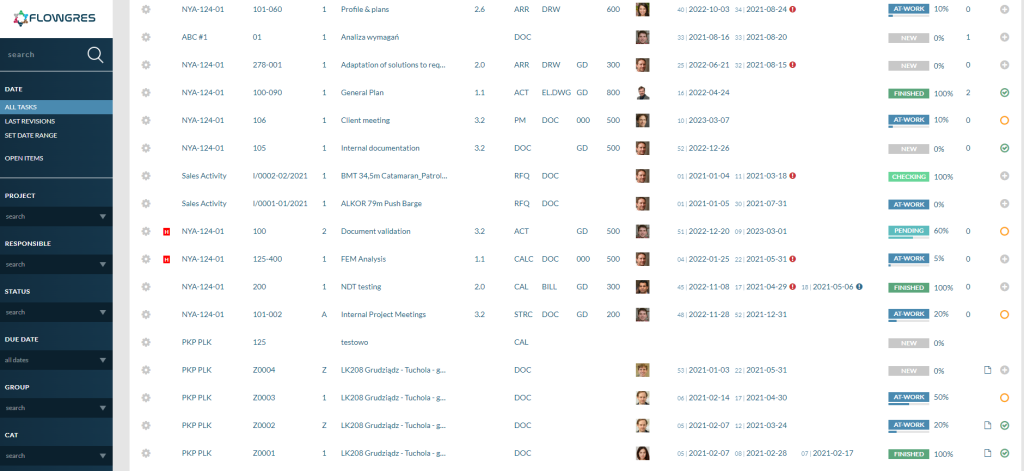
A task list allows us to monitor all ongoing processes in one place. It lets us review tasks and respond in a timely manner. It also gives us the ability to organize the work of teams within the company.
Resource Management
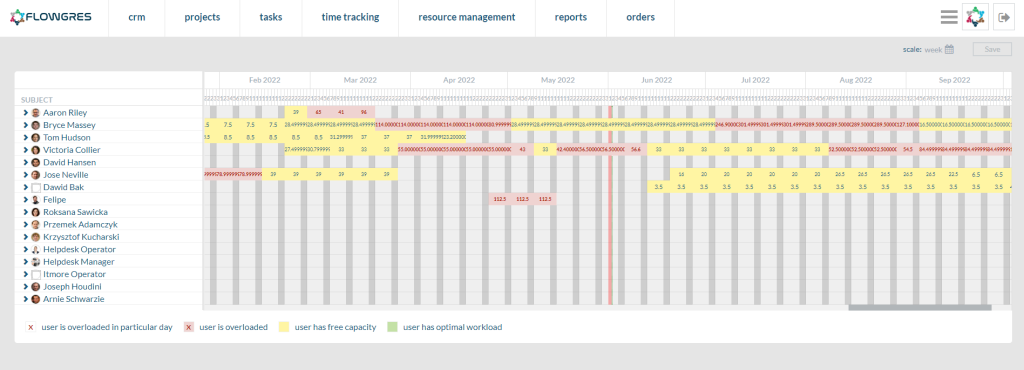
Resource management gives us the insight we need to assess the workload of both the team and individual employees. It allows us to see who has too much work and adjust task assignments as needed.
Gantt Chart
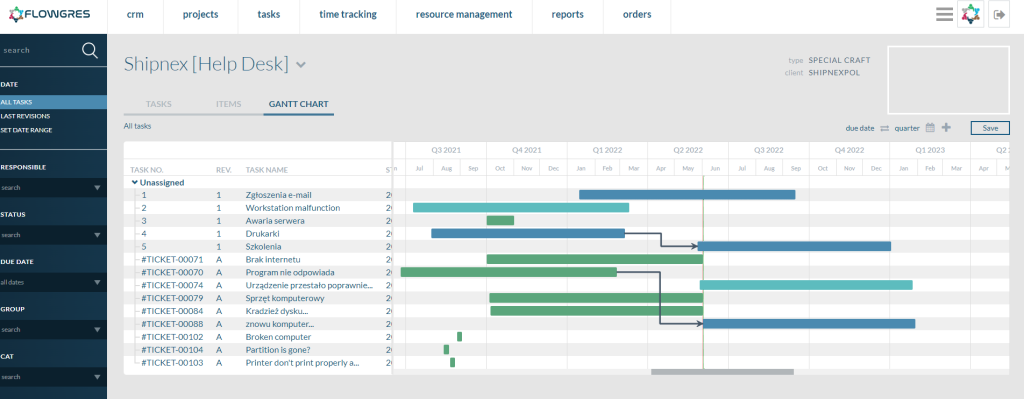
Gantt charts are horizontal bar charts used to visualize a project timeline. In a Gantt chart, tasks are represented as horizontal bars, with the length of each bar representing the duration of the task.
Team Communication
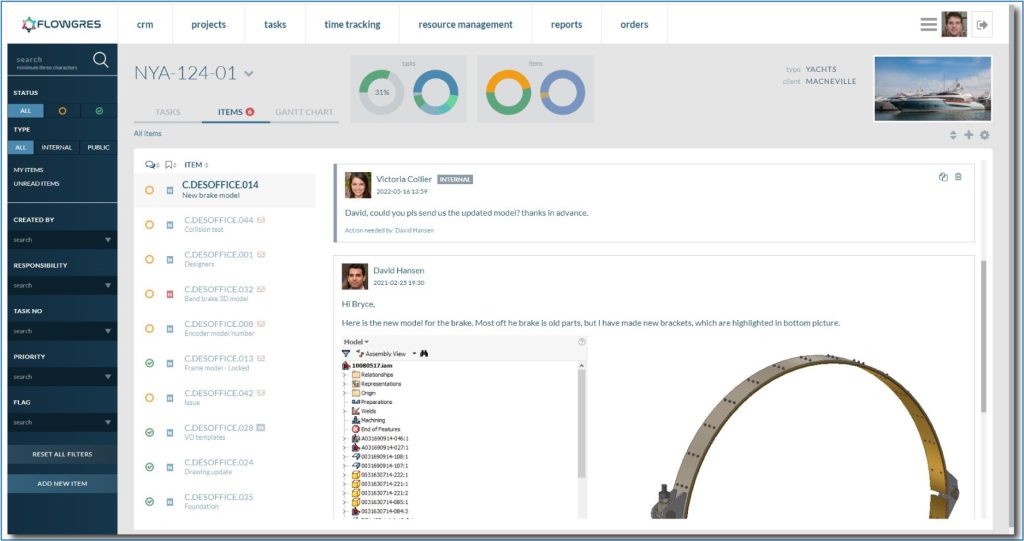
Team communication is the foundation of success in project management and for sharing important information. It can take the form of a single communication channel or separate, multi-threaded conversations gathered in one place and focused on a specific issue.
Find the right solution for you!
By implementing project and work management principles and techniques, you’ll benefit not only yourself but also the people you work with. Changes in planning, resource management, and time tracking will improve operational efficiency, enable project control, and help build competencies within the team.
The Flowgres system is a platform that provides the necessary tools for project management—a tool that will help you solve the problems you encounter along the way.
Learn more at www.flowgres.pl!

